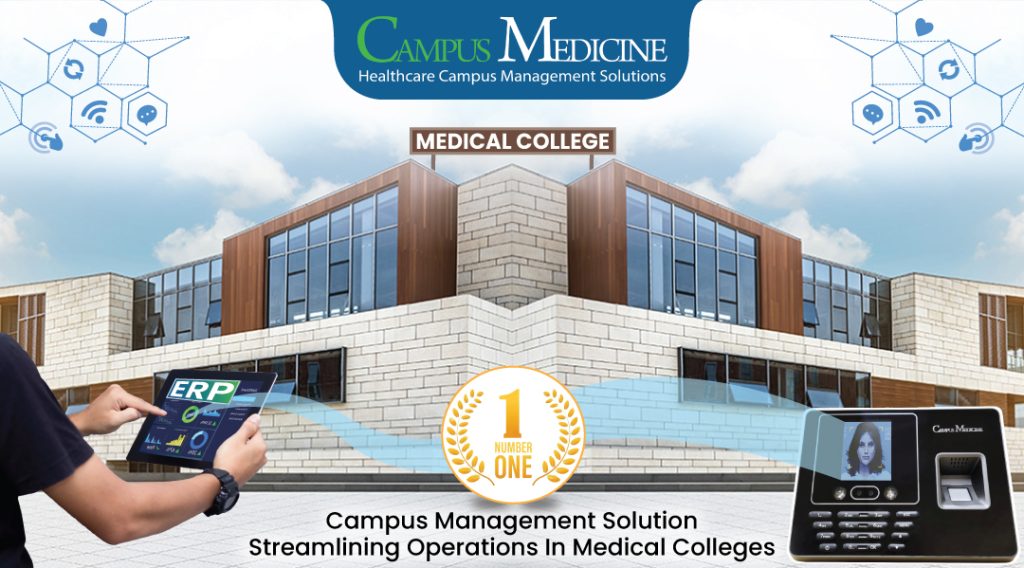
MBBS/ BDS Medical College is a renowned college known for its excellent faculty and extensive hands-on experience. As such a big institution, the college was facing various challenges in terms of managing admission processes, fee submission, recording attendance, hostel facilities, and other activities that are very crucial for a medical college. Manual processes were not only time-consuming but also prone to errors. To that end, the college administration was determined to find new perspectives and better solutions to old challenges.
Making technology a part of a transformative goal
Research and consideration led the college to select a comprehensive campus management solution with various modules suited to their specific needs. The solutions helped the college in numerous ways.
Admission process
Campus management’s admission module helped streamline the admission registration and enrollment process for students. Through its online platform, students could fill out and submit application forms, and the college was able to manage the admission processes effectively.
Attendance records
A real-time attendance module assisted the college in tracking and monitoring students’ attendance. In addition to marking attendance electronically, it generated reports and alerts for absenteeism. The software also allowed teachers to record attendance subject- and department-wise using their mobile phones and laptops.
Classroom management
From managing class schedules to taking care of the course materials, from keeping track of homework and assignments to sharing lecture details, the classroom management module catered to the needs of the institution keeping education on priority.
Examination module
The examination process is one of the painstaking tasks for medical institutes. Manual processes can often result in imprecise data. Nevertheless, the campus management solutions made things super easy. From setting up examination calendars to managing notifications, the software took care of it all in one place. It also linked exam details to grade reports and allowed students to take online exams.
Canteen
As part of the college’s canteen management, solutions were leveraged to keep track of food & beverage sales and management of the canteen operations. Students could place orders online and the canteen staff could manage orders and inventory more easily.
Hostel
Campus management solutions managed and maintained hostel admissions and occupancy records for the college. By using it, students were able to apply for hostel accommodation, and the college was able to manage the allocation of rooms more efficiently.
Fee process
To streamline the fee collection process, the college used the fees module. Besides providing students with a safe and convenient way to pay fees, it also facilitated the college’s management of fee collection.
Overall, the implementation of the campus management solution greatly improved the efficiency and accuracy of various campus activities at the MBBS/ BDS Medical College. It allowed the college to save time and resources and provided a seamless experience for students, faculty, and staff.
The paramount goal for medical colleges is to give rise to the number of competent doctors who have ample knowledge, are properly trained to deliver healthcare facilities, and have empathetic behavior towards their patients. There is no denying the fact that a great student makes an excellent doctor and attendance plays a very crucial part when it comes to a medical student’s academic performance and professional development as a doctor. If attendance is not kept in check, it can hamper students’ learning and further, their academic progress. Not just academic progress, absenteeism can also impact the zeal of the staff as well as other students.
For a profession that involves matters of life and death, even a small miss can cause big issues. Here are ten ways that medical colleges can adopt to improve attendance.
Implement a biometric attendance system that uses fingerprint, facial recognition, or hand scanner technology to accurately track student attendance.
Use biometric data to create personalized attendance reports for students, instructors, and administrators.
Leverage biometric technology to prevent fraudulent attendance or cheating on attendance records.
Integrate biometric data with other student information, such as grades and course progress, to provide a more comprehensive view of academic performance.
Use biometric data to identify patterns or trends in student attendance, such as times of day when attendance is consistently low.
Use biometric technology to create a secure and confidential record of student attendance, which can be accessed only by authorized personnel.
Implement a biometric attendance system that allows students to easily check in and out of classes using their fingerprints or other biometric data.
Use biometric data to automate the attendance tracking process and reduce the amount of time and effort required to maintain attendance records.
Implement a biometric system that allows students to access their attendance records and track their attendance progress.
Use biometric data to provide real-time attendance updates to instructors and administrators, allowing them to quickly identify and address any attendance issues.
Having biometrics administered in the daily activities of students can help organizations with the effective use of data effectively. Clearly, a biometric attendance management system for medicine colleges can enhance learning, and the future will see even more revolutionary usages. However, to ensure that all stakeholders as well as students benefit from the biometric system, medical colleges need to ensure students and staff are properly trained and supported in using biometric technology. It is advised to regularly evaluate and assess the biometric attendance tracking system to identify areas for improvement.
Over the next few weeks in my articles, I shall be elaborating on how medical campus ERP solutions act as an insurance for medical campuses by addressing the individual challenges faced by each of the key stakeholders in a healthcare education campus. We shall address issues and discuss probable solutions along with best international practices. Over this journey I shall also share a few case studies and success/failure stories as well. I shall be more than happy to address your queries or to learn from your experiences with respect to healthcare education campuses. Kindly feel free to email me.
The way education is imparted these days is way too contrasting to what it was years ago. Today’s classrooms have evolved to meet the new standards of education and technological ameliorations, especially after COVID. Educational institutions are also doing their best in upgrading their pedagogy and modules to match the demands of learners. They are investing in the best of technology including devices like laptops, tablets, and projectors. However, they fail to take care of one of the most important elements, which is providing students with specialized classroom furniture. While all other learning environment aspects are evolving, school furniture is still from the old days.
School furniture like chairs, desks, teacher’s tables, bookcases, etc. play a very important part and can create a positive impact on a child’s learning journey. If students spend their time in a classroom with uneasy chairs and desks, they will lack the motivation and excitement to learn. Not only will this affect their education but will also harm their health. If low-quality or imperfectly designed furniture is used, it can cause back and neck pain among students. It is therefore imperative that school furniture, and especially classroom furniture should be adaptive to children’s needs and educators’ teaching methodologies.
At SOURCE Partner, we combine our 19 + years of industry expertise in school furniture and education-centered thinking to create durable, multi-utility, safe, and exceptional quality school furniture for today’s education campuses. We are one of the most preferred and trusted names in school furniture offering superior and versatile furniture, and prompt delivery to any part of the country within a week.
Our furniture adheres to international safety standards, and resonates with modern-day students who are progressive, energetic, technology-savvy, and want to learn their way. SOURCE Partner’s designers create furniture that inspires young minds to be creative and confident enough to share their ideas. Our best-in-class classroom furniture includes tables, chairs, chairs and table sets, storage, lockers, cabinets, bookcases, carpets, wall décor, and much more; all of these are procured internationally from trusted vendors across 57 countries, considering design specifications, ergonomics and other vital criteria.
Workflows in higher education institutions like colleges and universities are essential for managing data security, student relationships, staff requirements, and other activities. When it comes to medical colleges, the complexity of the workflow increases due to the number of students, fee structure, courses, duration of courses, staff members, hostel facility, attached hospital, readiness to adopt new technology, staff competencies, and more. To justify the costs, keep up education standards, and attract the right kind of talent, a seamless workflow is necessary. ERP solutions such as Campus Medicine provide a platform to meet these needs; the solutions help in communication and data sharing, security protocols, access control, transport management, cafeteria management, report making, and fee implementation.
Here are 40 ways in which medical colleges can leverage ERP solutions.
Automating administrative tasks and processes
Centralizing and organizing student and faculty information
Enhancing communication and collaboration among staff and students
Simplifying scheduling and calendar management
Streamlining and tracking student admissions
Managing and tracking student grades
Streamlining the assessment and grading process
Improving the efficiency of financial management and billing
Safeguarding student and faculty data
Providing real-time access to data and information from any device
Improving the accuracy and timeliness of reporting and analysis
Streamlining the registration and enrolment process for classes and programs
Enhancing the tracking and management of student and faculty attendance
Providing online access to resources and tools for students and faculty
Improving the efficiency of communication and feedback between students and instructors
Tracking and management of professional development programs
Enhancing the coordination and collaboration among departments and programs
Streamlining and improving the overall management and operations of the college
Standardizing and streamlining data entry and data management processes
Enhancing the efficiency of training assessment and evaluation
Protecting research data and records
Providing easy access to key information and resources for students and faculty
Simplifying and improving the tracking and management of course schedules and curriculum
Enhancing faculty recruitment and retention
Streamlining the applications and paperwork process
Improving the coordination and scheduling of exams and assessments
Enhancing the tracking and management of faculty progress
Seamless supply of medical resources
Streamlining the tracking and management of campus budgets and expenditures
Streamlining and improving the tracking and management of student and faculty records and documents
Enhancing the efficiency of feedback between students and instructors
Providing online access to academic and administrative resources for students and faculty
Improving the coordination and collaboration among stakeholders
Streamlining and improving the management and operations of the college
Enhancing the tracking and management of campus resources and facilities
Improving the coordination and scheduling of events and activities
Enhancing the accuracy of campus maintenance and repairs
Strengthening the tracking and management of campus food services and dining options
Easy management of campus transportation and parking
Improving the tracking and management of education and training certificates as well as credentials
Over the next few weeks in my articles, I shall be elaborating on how medical campus ERP solutions act as an insurance for medical campuses by addressing the individual challenges faced by each of the key stakeholders in a healthcare education campus. We shall address issues and discuss probable solutions along with best international practices. Over this journey I shall also share a few case studies and success/failure stories as well. I shall be more than happy to address your queries or to learn from your experiences with respect to healthcare education campuses. Kindly feel free to email me.
ERP or Enterprise Resource Planning has seen an impressive growth in almost all sectors with the Healthcare education sector being no exception. Campus management solutions (ERP) in healthcare education are critical because of the huge investments and long-term impact of improved workflow for all stakeholders. The courses that are delivered in healthcare education institutions, government and private colleges alike are of great national importance and act as the growth triggers of the future. Therefore, it is imperative to manage campus workflows/processes with maximum efficiency.
Deep Communication gaps between key stakeholders due to lack of a common platform.
Lack of Accountability and Transparency
Information technology adoption Deficiency
Lack of IT infrastructure
Absence of Structured MIS reports
Lack of Role and Time management
Lack of timely and efficient coordination between various departments
No data mining
Lack of Quality goals setting in both education standards and campus management 10. No Regular audits on workflow efficiency
For any medical institute to be at par, there should be a healthy relationship as well as clear communication between its major stakeholders involving Investors, Top Management, Principal, AO, HOD’s, Faculty, Students, Parents, Non-teaching staff, and Alumni. Without a robust and tangible campus management ERP, efficient campus communication is next to impossible. Campus management solutions can therefore act as a Communication-Bridge Insurance between all stakeholders of medical education institutes.
I strongly believe that there are only two key Investors in a medical education Campus. Management/government who invest in finance and infrastructure and Parents who bid the future of their most valuable assets, “their children” by enrolling and paying for their education . If the ROI of these two is protected, there is no way a Campus can ever fail.
For the investor management, power does not reside in ownership alone. Today power is a function of efficient data collection, data mining and thereafter prompt and timely usage of the learnings for better productivity. A good campus ERP can provide a live dashboard interface for the investors on a real time basis and hence protect their monetary and brand equity.
For parents who invest a whopping amount of money towards their child’s medical education, ERP solutions enable transparent and two-way communication. Healthcare education management solutions help Parents keep a track of their child’s educational journey from attendance, examination results, fee due dates, fines, to other critical information. The advanced tools under ERPs also promptly issue critical timely alerts to the parents around all academic and non-academic progress parameters for their ward thus avoiding any last minute shocks or surprises.
Some of the features that institutes should look at while searching for ERP solutions for medical college are:
Trustworthiness: The system will collect your crucial and sensitive data, so make sure that the solution provider is trustworthy.
Customization: Different healthcare institutions have different needs. When it comes to ERP solutions for medical colleges, the ERP system should offer customized services and solutions enabling smooth workflow automation.
Stakeholder friendly: It should cater to the needs of all stakeholders and provide maximum user satisfaction.
Integration: Every institution has unique workflows. While selecting the ERP solution for the campus, leadership should consider how well the new solution can align/integrate with the current workflows/userbase/infrastructure.
Seamless support: Once the ERP solutions are integrated, universities/campuses will also need continuous support from the solution provider. So, it is better to select the ERP solutions provider with an adequate experience and an established after-sale support protocol.
One-stop workflow: Make sure the ERP solution streamlines the complete campus workflows, from pre-admission to alumni management.
Over the next few weeks in my articles, I shall be elaborating on how medical campus ERP solutions act as an insurance for medical campuses by addressing the individual challenges faced by each of the key stakeholders in a healthcare education campus. We shall address issues and discuss probable solutions along with best international practices. Over this journey I shall also share a few case studies and success/failure stories as well. I shall be more than happy to address your queries or to learn from your experiences with respect to healthcare education campuses. Kindly feel free to email me.